
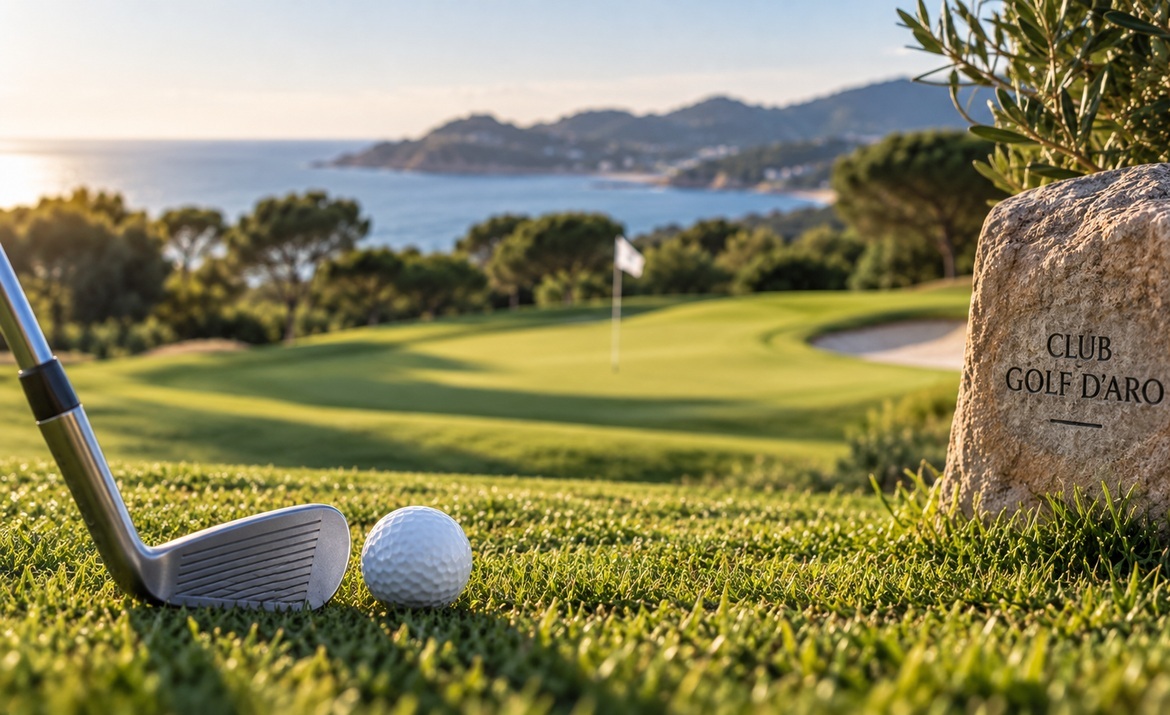
When a player approaches the green, there is one thing that immediately catches their eye: the flag.
It makes sense. It marks the hole and represents the ultimate goal. However, focusing solely on it can lead us to make decisions that aren’t always the best ones.
Between our ball and the flag lies something much more important: the area where we want the ball to land.
The slope of the green, the bunkers, the available space, the type of shot, and the position of the flag may mean that aiming directly at the hole isn’t necessarily the best option.
Learning to focus first on the landing area in golf and then on the final result significantly changes the way you approach shots toward the green.
The flag indicates where the hole is, not necessarily where you should play
Seeing a flag in the middle of a wide green makes the decision a lot easier.
But not all positions are like that.
A flag can be found near a bunker, along the edge of the green, behind a slope, or in an area with very little room for error.
In such situations, an important question arises:
Do I really need to play “Capture the Flag” directly?
To answer this question, we must distinguish between the ultimate goal and the objective of the strike.
Our ultimate goal is to sink the ball.
But the immediate goal might be to land it in a specific area of the green from which we’ll have a good chance to continue playing.
This difference may seem small, but it’s part of the strategy in golf.
Before looking at the flag, take in the whole green
When we’re preparing for an approach, it’s very easy to focus exclusively on the distance to the flag.
For example: 125 meters.
We automatically start thinking about which club we usually use for that distance.
But first, there is something else worth noting.
Where does the green start?
Where does it end?
Is there more space on the right or on the left?
Where are the bunkers?
Is there a steep slope?
Where would it be better to fail?
This last question is particularly useful.
In golf, not all mistakes have the same consequences. A ball that lands five meters to the left might leave us with a perfectly playable putt. Five meters to the right could mean ending up in a bunker.
That’s why knowing the safe zone on the green can be more important than aiming exactly at the flag.

The landing point completely changes an approach
This concept is even more evident in short shots around the green.
Let’s imagine we’re just a few meters away and want to make a roll-in approach.
It doesn’t make much sense to focus solely on the hole.
First, we need to decide where we want the ball to land on the green.
Next, we need to estimate approximately how far it will travel while rolling.
In situations like this, the stroke can be mentally divided into two parts:
flight + taxiing.
If we choose the spot where the ball should land carefully, it’s much easier to control the outcome.
That’s why players with a good short game don’t just look at the flag. They also carefully study the terrain between the ball and the hole.
The slope can turn a good line into a bad decision
Greens are not completely flat surfaces.
They have slopes, platforms, drops, and areas where the ball can quickly gain or lose speed.
A flag may seem within reach from our position, but if attacking it directly requires landing the ball on a tricky slope, there may be a safer alternative.
Sometimes it’s better to leave the ball just below the hole.
On other holes, it’s best to avoid an area from which we’d have a particularly tricky downhill putt.
The strategy involves thinking not only:
“How do I get to the flag?”
but also:
“Where do I want to play my next shot from?”
This second question changes the way we interpret the green.
Bunkers alter the true size of the target
Let’s suppose we’re facing a relatively large green.
On paper, it seems like an easy goal.
But the flag is located very close to a bunker.
Suddenly, psychologically speaking, our goal becomes much smaller.
We tried to get the ball close to the hole, but we ended up playing toward the most dangerous area.
This is where it’s helpful to broaden our perspective once again.
There may be fifteen meters of green on the other side of the flag and only three between the hole and the bunker.
The decision should no longer be based solely on which route is the most direct.
We must also assess what margin of error we have around the target.

Sometimes finishing eight meters from the flag is a good result if the alternative was to take an unnecessary risk.
Attacking the flag doesn’t always mean playing better
One of the hardest concepts to accept is that a spectacular play isn’t always the best decision.
When we see a vulnerable target, we’re tempted to attack.
And in some situations, that’s actually possible.
But in other cases, the relationship between reward and risk is very different.
A flag located in a narrow part of the green may require a level of precision that might not be worth the effort, depending on our distance, skill level, or the current conditions.
Playing toward a wider area may seem less ambitious, but it increases your chances of keeping the ball in play.

This ties in with something we’ve already discussed when talking about the toughest decisions on a golf course: a good decision doesn’t always produce the most spectacular result, but rather the one that offers a reasonable balance between risk and reward.
The distance to the flag doesn’t tell the whole story either
GPS devices and rangefinders have greatly changed the way the game is played.
Today we can determine the distance to a target in meters with a high degree of accuracy.
But having an exact figure doesn’t mean you have all the information.
It’s helpful to know that we have 140 meters to go until the flag.
It’s even better to know that it’s 125 meters to the front of the green and 155 to the back.
Suddenly, we have an area of about thirty meters where our ball could land.
That allows you to choose the club from a different perspective.
Instead of simply asking ourselves:
“Which club hits 140 meters?”
We might think:
“Which shot gives me the best chance of landing within that area?”
This approach is especially helpful when the flag is located near one end of the green.
The wind and the elevation change are shifting our landing zone
The area we choose isn’t always the same either.
The wind can affect the ball’s trajectory, and a slope can change the effective distance of the shot.
That is why we must adapt our goal to the circumstances.
If there is a crosswind, for example, aiming directly at the flag might mean the ball ends up far from it. Our starting point should account for some of that deviation.
Something similar happens with a green that is elevated or located well below our position.
We’ve seen on other occasions how wind, temperature, and elevation changes affect the ball’s distance. Here, those same factors have a strategic implication: they change where we expect our shot to land.
Aiming for the center of the green can be an excellent strategy
“Aim for the center of the green” is one of those tips that might seem too simple.
However, it makes a lot of sense in many situations.
The center usually has more space around it.
Reduces the effect of flags placed near obstacles.
And it allows for minor deviations without them necessarily becoming a major problem.
This doesn’t mean you always have to play through the middle.
An accessible flag, a comfortable distance, and good conditions may call for a more aggressive shot.
The key is to make attacking the flag a conscious decision rather than an automatic response.
The strategy must be tailored to each player
There is no single correct area that works for everyone.
A player with great accuracy from 80 meters can take on smaller targets than another player who is still developing that aspect of his game.
The same is true for long distances.
The lower our usual accuracy, the larger the range we should consider valid.
This doesn’t mean playing with fear.
It means knowing our game.
A realistic strategy is based on our actual distances and our typical dispersion, not on the best shot we’re capable of hitting.
On a varied course such as Golf d’Aro, figuring out where we want to land the ball before each shot helps us better interpret the elevation changes, obstacles, and different areas of the course.
Start planning your next move in advance
This concept isn’t limited to approaches.
We can also use it off the tee.
Instead of just thinking about where we want our outing to end, we can ask ourselves:
From what position do I want to play my next shot?
Perhaps the left side of the fairway offers a much better approach to the green.
Gaining twenty meters off the tee might not be an advantage if it leaves us with a worse angle.
Perhaps playing a slightly shorter shot removes one obstacle from the equation.
When we start thinking that way, we stop playing isolated shots and start building the entire hole.
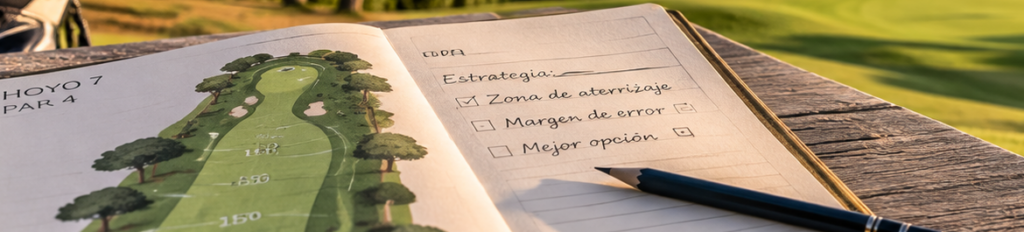
A quick routine to help you choose the right lens
Before hitting a shot toward the green, it can be helpful to follow a very simple process.
First, look at the flag.
Then, stop looking at her for a few seconds.
Take a look at everything around you.
It detects obstacles, slopes, and areas with more space.
Think about where you’d rather fail.
Finally, decide what your real goal will be.
Sometimes it will match the flag exactly.
In other cases, he will be several meters away from her.
Both decisions could be correct.
The important thing is that there be a reason behind the choice.
Don’t just play toward the hole
The flag is a key point of reference, but it shouldn’t monopolize our attention.
A good approach strategy in golf takes into account where we want the ball to land, how far it will roll, what obstacles are present, and where we prefer to play our next shot from.
Thinking in terms of zones rather than exact points also makes it easier to accept small mistakes.
We don’t always have to execute the perfect shot.
We need to choose a target that allows a reasonably good shot to also produce a reasonably good result.
The next time you’re approaching a green, look at the flag.
But then look at everything around him.
You’ll probably find the information you really need to decide on the shot there.
If you want to put this strategy into practice, you can book your round at Golf d’Aro and tackle the course by thinking not only about where you want to finish, but also where you want your next shot to start.