

A well-maintained green may seem like a given. Its even surface, the color of the grass, and the smoothness with which the ball rolls convey a sense of simplicity. However, ensuring that a green offers good playing conditions requires planning, technical expertise, and constant maintenance.
On a golf course, the condition of the greens directly affects the quality of the experience. It’s not just a matter of aesthetics: the firmness, moisture content, grass density, and evenness of the surface can all affect the speed of the ball and the difficulty of each putt.
Understanding what goes on behind the scenes with course maintenance allows you to better appreciate the course and understand why playing conditions can vary from one day to the next.
The green: one of the most challenging surfaces on a golf course
Although it occupies a relatively small portion of the course, the green is one of the areas that requires the greatest precision in its maintenance.
Unlike other areas of the course, the grass on the green is kept at a particularly short height. This allows the ball to roll more evenly, but it also makes the grass more sensitive to certain environmental conditions and wear and tear.
To maintain the proper balance, maintenance teams must pay attention to various factors:
- The height and frequency of mowing.
- Soil moisture and irrigation needs.
- Compaction and drainage capacity.
- The health and density of the lawn.
- Wear and tear caused by players moving around.
Each of these factors affects the surface’s performance. That is why a high-quality green does not depend on a single task, but rather on the coordination of various tasks throughout the year.
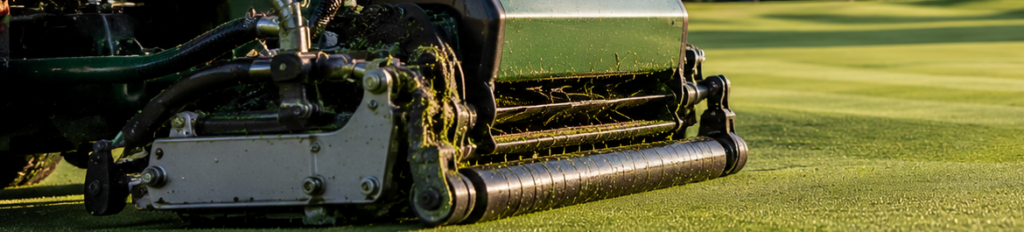
Mowing the lawn: much more than just a matter of aesthetics
One of the most visible aspects of maintenance is mowing. However, its purpose goes far beyond simply creating a visually uniform surface.
The height of the grass affects the resistance the ball encounters as it rolls. Generally speaking, a shorter surface may allow the ball to roll faster, although speed also depends on moisture, grass density, and other conditions.
Mowing too low or too frequently can put unnecessary stress on the lawn.
For this reason, the priority is not always to get the green ready as quickly as possible, but rather to maintain a healthy, even surface that is suitable for play.
In addition, the precision of the machinery and the condition of its blades are important for achieving a clean cut and preventing damage to the leaves.
Why are some greens faster than others?
The speed of a green is one of the things players notice most, especially when it comes time to putt.
But there is no single ideal speed for all circumstances. A very fast green can be particularly challenging if it has steep slopes or difficult flag positions.
Factors that can affect speed include grass height, surface moisture, soil firmness, and certain maintenance tasks.
The design of the green itself also plays a role.
The same speed can produce very different sensations depending on the slope and the ball’s path. That’s why a fast green isn’t necessarily better than a slower one: what matters is that the conditions are consistent and allow for a balanced game.
For golfers, adapting to these variations is part of the experience. Spending a few minutes on the putting green before teeing off can help you adjust your stroke and improve your sense of the ball’s roll.
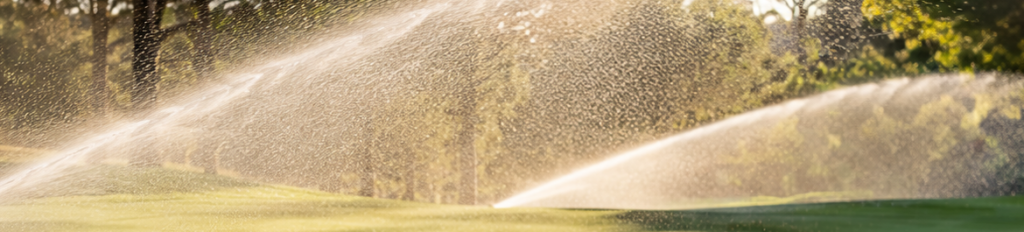
Watering: Finding the Right Balance
Water is essential for maintaining a lawn, but too much water does not necessarily guarantee better results.
A green that is too wet may have a softer surface, cause more divots, and affect how the ball behaves.
On the other hand, a prolonged lack of moisture can cause stress to the lawn and affect its ability to recover.
Irrigation management involves providing the necessary amount of water without compromising plant health or playing conditions.
In areas with a Mediterranean climate, such as the Costa Brava, this planning takes on special importance due to the combination of dry periods, high temperatures, and episodes of heavy rain.
The goal is to promote a hardy lawn and the efficient use of water resources.
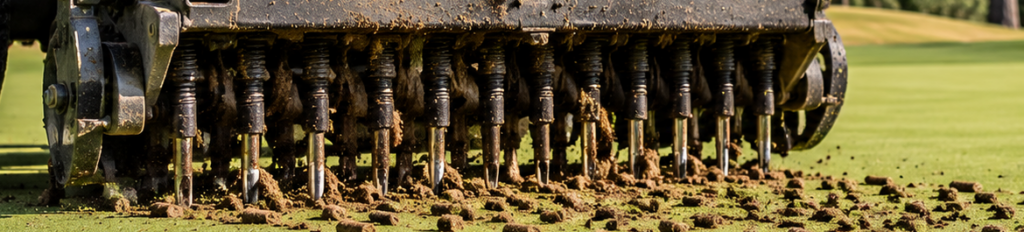
Soil aeration: an essential task that isn’t always noticed
Over time, foot traffic, machinery, and other factors can contribute to soil compaction. When this happens, it becomes more difficult for water, oxygen, and nutrients to reach the roots properly.
Aeration is one of the techniques used to improve these conditions. It involves making small holes in the soil using various methods to promote air exchange and water movement.
In certain procedures, small cylinders of soil are also removed, a practice that can leave visible marks for a few days.
Although these measures may temporarily alter the ball’s roll, their purpose is to promote the health of the turf and the long-term quality of the playing surface.
It is important to understand that a recently aerated green is not necessarily a neglected green. In many cases, temporary changes are part of preventive maintenance.
Surface Preparation and Leveling
Another common technique in green maintenance is topdressing.
This involves applying a thin layer of sand or another suitable material to the lawn. Depending on the soil characteristics and maintenance goals, this process can help improve surface uniformity, manage the accumulation of organic matter, and enhance certain soil properties.
When done correctly, the material gradually blends in among the blades of grass.
For the player, its presence may be noticeable for a limited time. However, the receiver is an important tool for maintaining a stable and consistent surface.
The combination of different techniques makes it possible to address not only the visible appearance of the green but also the soil conditions that support the turf.
The Climate of the Costa Brava and Its Impact on Maintenance
Golf courses located in Mediterranean settings must adapt to weather conditions that change significantly throughout the year.
During the summer, high temperatures and increased evaporation can lead to higher water needs. In the fall, rainfall and fluctuating temperatures make it necessary to adjust maintenance efforts.
Wind also affects moisture loss and can cause differences between exposed areas and more sheltered ones.
In a setting like that of Club Golf d’Aro – Mas Nou, located in Platja d’Aro, understanding these conditions helps one appreciate the complexity of maintaining a golf course.
Lawn care requires adapting to actual conditions, rather than applying exactly the same practices year-round.
The Importance of Repairing Divots on the Green
Professional maintenance is essential, but players also play an important role in preserving the course.
One of the simplest and most helpful things you can do is to properly repair the divots left by a ball when it lands on the green.
These marks, known as divots, can alter the surface and affect the roll of balls that subsequently pass through that area.
To repair them, use a divot repair tool, gently pushing the grass from the edges toward the center of the mark without disturbing the soil underneath. You can then smooth out the surface with a putter.
Taking a few seconds to fix a dent helps maintain better playing conditions for all players.
It’s also important to avoid dragging your feet on the green, to handle the flag carefully, and to follow the course rules.
These are small habits that, when repeated over the course of many games, have a positive effect on maintaining the course.

A good green is the result of many decisions
When a player reaches the green, he or she usually focuses on the slope, the distance to the hole, and the force needed to make the putt.
However, behind that facade lie numerous technical decisions that influence its behavior.
Maintenance must strike a balance between various objectives: maintaining the health of the turf, ensuring consistent playability, managing water efficiently, and reducing wear and tear caused by use.
It is not always possible to optimize all of these aspects at the same time. For example, striving for extreme speed may conflict with the turf’s durability under certain conditions.
For this reason, the quality of a green should be judged by its balance, consistency, and sustainability—not solely by its speed or appearance.
Enjoying golf also means understanding the course
Understanding how a green is maintained allows you to see the course from a different perspective.
A slightly wetter surface, a change in speed, or recent maintenance work may explain why a ball behaves differently than expected.
Instead of viewing all these variations as a problem, the player can learn to recognize them and adapt their game.
This ability to observe is part of golf: understanding the surroundings, interpreting the conditions, and making the right decisions in every situation.
A green in good condition is the result of ongoing effort that combines technical knowledge, planning, and attention to detail.
From mowing and watering to aeration and soil care, each task serves a specific purpose. Although many of them go unnoticed during a round, they all help ensure that the player can enjoy the course.
At Club Golf d’Aro – Mas Nou, the Costa Brava setting invites you to enjoy golf while paying attention to the game, the scenery, and the course’s unique features.
The next time you line up for a putt, take a moment to look at the surface as well. There’s a lot more work that goes into each green than meets the eye.
Would you like to enjoy a day of golf on the Costa Brava? Discover our golf course and check out our booking options.